

Product compliance failures are among the most costly — and most preventable — disruptions an organisation can experience. A single non-conformance discovered after market launch can trigger product recalls, regulatory enforcement, retailer delisting, and lasting reputational damage. Third-party lab testing, conducted by accredited and independent laboratories, has therefore emerged as the foundational discipline through which manufacturers, importers, and brand owners verify that their products meet the safety, performance, and regulatory standards required by their target markets.
As consumer protection frameworks tighten across major economies and supply chain due diligence legislation expands its scope, the role of independent lab verification has shifted from a procedural checkpoint to a strategic safeguard. According to McKinsey & Company research on operational resilience, organisations with mature quality assurance and testing infrastructure consistently demonstrate lower incidence of recall events, faster regulatory clearance, and stronger commercial outcomes in regulated markets.
This guide outlines what organisations should expect from a credible third-party lab testing engagement, the certification pathways most relevant to globally traded products, and the criteria by which accredited laboratories and certification partners should be selected.
Regulatory Pressure and the Rise of Independent Testing
Regulatory expectations across consumer goods, electronics, industrial components, and materials-intensive product categories have grown markedly more rigorous over the past decade. The European Union’s CE marking framework, the United States’ Consumer Product Safety Commission requirements, and a widening array of country-specific product safety regimes across the Asia-Pacific region each impose detailed obligations on the technical documentation and test evidence that must accompany a product to market.
Internal or supplier-conducted testing, however well-intentioned, rarely satisfies these obligations in full. Regulators, retailers, and major buyers increasingly require evidence generated by accredited, independent laboratories operating under recognised quality management standards — most commonly ISO/IEC 17025, the international benchmark for testing and calibration laboratory competence.
Research from Deloitte’s Global Chief Procurement Officer studies consistently underscores that supplier quality and compliance failures rank among the most disruptive procurement risks — and that organisations applying structured product compliance testing protocols experience materially lower exposure to these failures than those relying on supplier self-declaration.
The Role of Independent Lab Verification in Product Compliance
Independent verification fulfils three distinct functions within a mature compliance programme, each of which warrants explicit consideration during the design of a testing strategy.
1. Regulatory Conformity Assessment
The first and most familiar function is the generation of test evidence required for regulatory market access — CE marking technical files for the European market, FCC and UL test reports for North America, CCC certification for the Chinese domestic market, and equivalent frameworks in other jurisdictions. Each regime specifies the test standards, methodologies, and laboratory accreditation requirements that must be satisfied, and accepts only documentation produced by competent independent bodies.
2. Quality Verification and Performance Validation
Beyond statutory compliance, third-party laboratories provide objective verification that products perform to declared specifications. This dimension of quality certification services is particularly important for organisations selling into demanding business-to-business markets, where contractual performance warranties create direct commercial exposure to product quality variance.
3. Supply Chain Assurance
The third function, increasingly prominent in cross-border sourcing, concerns ongoing verification that suppliers continue to produce to the qualified specification over time. Periodic third-party testing of production samples, supported by structured supplier certification support, provides the evidence base required to detect drift, substitution, or process deterioration before defective product reaches the market.
Key Certification Frameworks for Globally Traded Products
The certification landscape is extensive, but a relatively small number of frameworks account for the majority of testing demand across globally traded consumer and industrial products.
Product CE Certification for the European Market
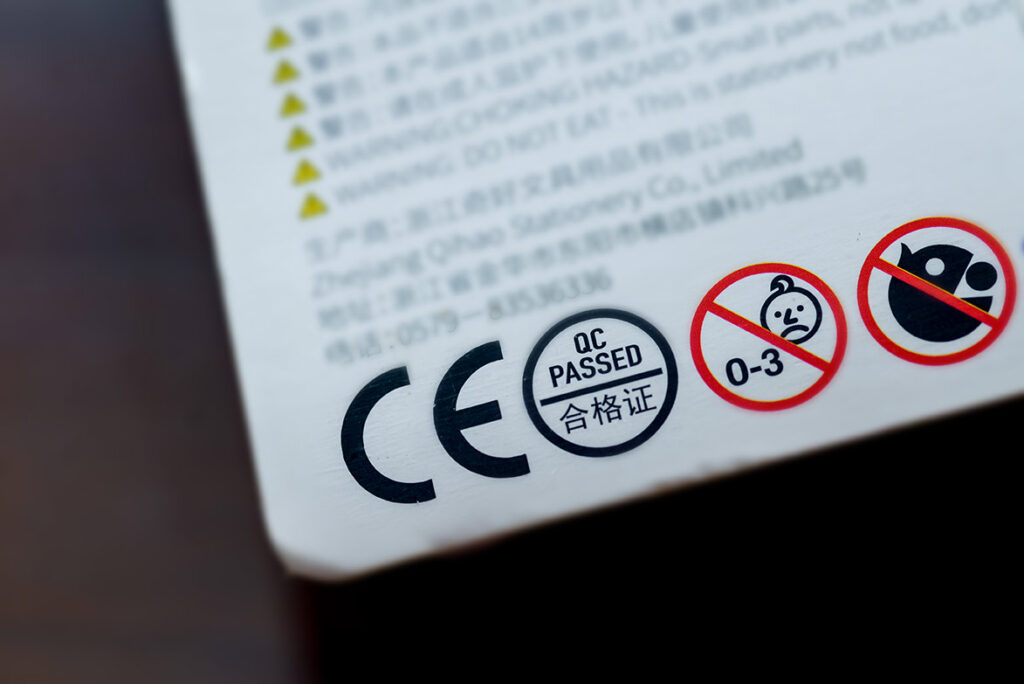
CE marking is mandatory for a broad range of products placed on the European Economic Area market — including electronics, machinery, toys, medical devices, personal protective equipment, and construction products.
Product CE certification requires the manufacturer to compile a technical file demonstrating conformity with the applicable EU directives or regulations, supported by test evidence against harmonised European standards. For higher-risk product categories, intervention by a Notified Body is also required. The European Commission’s official guidance on CE marking sets out the legal framework and conformity assessment procedures in detail.
ISO Management System Certification
Beyond product-specific certification, supply chains routinely require evidence of management system maturity. ISO certification suppliers demonstrate conformity to internationally recognised standards including ISO 9001 (quality management), ISO 14001 (environmental management), ISO 45001 (occupational health and safety), and category-specific standards such as IATF 16949 for automotive and ISO 13485 for medical devices.
While management system certification does not in itself verify individual product compliance, it provides material assurance regarding the systemic capability of the supplier to deliver consistent quality.
North American and Asia-Pacific Frameworks
Products destined for North America typically require FCC certification for radio-frequency emissions, UL or equivalent certification for electrical safety, and FDA registration for regulated categories including medical devices, food contact materials, and cosmetics.
Across the Asia-Pacific region, frameworks including China’s CCC, Japan’s PSE, Korea’s KC, and Australia’s RCM each impose specific testing and certification requirements that must be addressed early in product development to avoid retrofit costs.
Materials Safety Testing: A Specialist Domain
For products incorporating regulated materials — including textiles, toys, food-contact items, cosmetics, and electronics — materials safety testing forms a distinct and technically demanding component of the overall compliance programme. Restricted substances regulations — including the EU REACH framework, RoHS Directive on hazardous substances in electronics, California’s Proposition 65, and the Toxic Substances Control Act in the United States — impose specific limits on a wide and expanding list of chemicals and heavy metals.
Demonstrating compliance requires laboratory analysis using validated analytical methods, typically employing techniques such as gas chromatography-mass spectrometry, inductively coupled plasma analysis, and high-performance liquid chromatography. Accredited laboratories with established expertise in restricted substances testing are therefore essential partners for any organisation placing such products on regulated markets.
The strategic importance of this discipline has only grown as regulators expand the scope of restricted substances lists and tighten enforcement.
Selecting an Accredited Third-Party Lab Testing Partner
The credibility of test evidence is inseparable from the credibility of the laboratory that produced it. Selecting an appropriate third-party lab testing partner therefore warrants the same structured evaluation applied to any strategic supplier engagement.
1. Accreditation Scope and Recognition
The starting point is laboratory accreditation under ISO/IEC 17025, granted by a recognised national accreditation body operating under the International Laboratory Accreditation Cooperation (ILAC) Mutual Recognition Arrangement. Crucially, the accreditation scope must explicitly cover the test methods and product categories relevant to the engagement — accreditation for an unrelated test discipline carries no weight for the standards in question.
2. Notified Body and Certification Body Status
For products requiring intervention by a Notified Body under EU regulations, or by a Nationally Recognized Testing Laboratory (NRTL) under United States schemes, the laboratory’s formal designation under the relevant framework is a non-negotiable requirement. Engagement with a laboratory lacking the necessary designation will not yield evidence acceptable to the relevant regulator.
3. Technical Depth and Sector Experience
Within an accredited scope, laboratories vary materially in their technical depth and experience with specific product categories. Evaluation should assess the laboratory’s engineering and scientific staffing, equipment generation, sample throughput, and demonstrable track record with comparable products.
4. Geographic Coverage and Sample Logistics
For organisations sourcing from Asian manufacturing markets, the laboratory’s physical presence in the relevant production region materially reduces sample logistics costs, turnaround times, and the operational friction associated with cross-border movement of test specimens. A laboratory network spanning both production and destination markets typically delivers the best combination of cost, speed, and regulatory acceptance.
5. Reporting Quality and Defensibility
Test reports are the durable artefact of the engagement and must withstand scrutiny by regulators, customers, and — in adverse scenarios — litigation. Reporting quality, traceability of measurement uncertainty, and the clarity of conclusions should be assessed through sample reports prior to engagement.

Structuring the Testing and Certification Process
A disciplined testing programme proceeds through clearly defined phases, each producing documented evidence that supports the next.
PHASE ONE: REGULATORY MAPPING AND TEST PLAN DEVELOPMENT
The process begins by establishing the full set of regulatory and contractual requirements applicable to the product across its intended markets. Output is a structured test plan identifying the standards, methods, sample quantities, and acceptance criteria that the testing programme must address.
PHASE TWO: PRE-COMPLIANCE SCREENING
Where development timelines or cost considerations warrant, pre-compliance screening conducted on prototypes or early production samples identifies likely failure modes before formal certification testing is commissioned. Early identification of non-conformities is materially less expensive to remediate than failure at the formal certification stage.
PHASE THREE: FORMAL COMPLIANCE TESTING
Formal testing is conducted against the agreed test plan, using production-representative samples, by an accredited laboratory under controlled conditions. Test reports are issued under the laboratory’s accreditation scope and become the cornerstone of the technical documentation file.
PHASE FOUR: CERTIFICATION, MARKING, AND DOCUMENTATION
Successful test outcomes enable the manufacturer to declare conformity, apply the relevant compliance markings, and compile the technical file required under the applicable regulatory framework. For frameworks requiring third-party certification, the certification body issues the formal certificate following review of the technical file and, where applicable, factory inspection.
PHASE FIVE: ONGOING SURVEILLANCE AND PERIODIC RE-TESTING
Compliance is not a single event. Regulatory frameworks routinely require ongoing surveillance — including periodic re-testing, factory audits, and notification of design changes — to maintain certification validity. A structured surveillance programme, supported by appropriate supplier certification support, is essential to sustained market access.
Third-Party Lab Testing in Asian Sourcing Contexts
The geographic concentration of global manufacturing across China, Vietnam, Taiwan, India, and neighbouring economies has been accompanied by significant investment in laboratory infrastructure within the region. Accredited testing facilities in major industrial centres routinely deliver capability equivalent to that of long-established laboratories in Europe and North America — and frequently at materially shorter sample-to-report timelines, given their proximity to production sites.
For organisations engaged in independent lab verification of Asian-sourced products, this regional laboratory network represents a strategic asset. Effective utilisation, however, requires careful selection of accredited partners, structured oversight of sample chain-of-custody, and alignment of test scopes with the regulatory requirements of the destination market.
Engaging an experienced trusted partner with established regional networks, integrated procurement services, and the supply chain visibility to coordinate testing across multiple suppliers materially reduces the friction associated with cross-border compliance programmes.
Common Pitfalls in Third-Party Testing and Certification
Several recurring failure modes undermine otherwise well-resourced compliance programmes. Awareness of these pitfalls supports their preemption.
The most prevalent include:
- engagement of laboratories whose accreditation scope does not cover the relevant test methods;
- reliance on supplier-supplied test reports without independent verification
- selection of samples that are not production-representative
- insufficient planning for re-testing following design or supplier changes;
- failure to maintain a current and complete technical file.
Each pitfall is preventable through procedural discipline and the application of an evidence-based testing protocol.
Sustainable Compliance and Testing Programme
For organisations placing multiple products onto multiple markets, product compliance testing must be approached as a sustained capability rather than a series of discrete projects. A standardised programme — combining a qualified panel of accredited laboratories, structured test plan templates, centralised technical file management, and integrated surveillance scheduling — delivers materially better outcomes than ad hoc testing arrangements.
Investment in this capability typically pays back through reduced incidence of market access delays, lower exposure to recall and enforcement events, faster time-to-market for new products, and stronger commercial standing with retailers and channel partners that require evidence of robust compliance practice.
For organisations operating across Asian manufacturing markets, integration of testing programmes with broader quality certification services and supplier oversight delivers compounding benefits across the supply chain.
Independent Verification as the Foundation of Market Access
The discipline of third-party lab testing sits at the intersection of regulatory compliance, quality assurance, and brand protection. Approached with rigour, it provides the evidence base on which products are accepted into regulated markets, sold to demanding customers, and defended in the event of subsequent challenge.
The frameworks and best practices outlined in this guide reflect the standards expected of mature compliance organisations.
For businesses sourcing across Asian manufacturing markets, the additional complexity of cross-border testing and certification makes the engagement of regional supplier certification support,backed by accredited laboratory partners and robust supply chain visibility, a practical necessity rather than a discretionary choice.
If your organisation is evaluating its independent lab verification approach, navigating product CE certification, or coordinating materials safety testing across Asian suppliers, we invite you to contact CSC Partners team to discuss your requirements.
Our consultants are available to outline how integrated procurement services, accredited laboratory networks, and regional expertise can support a more disciplined and defensible compliance programme.
Related reading: Supplier assessment and vendor qualification and ESG audit services for global supply chains.
