

Few procurement decisions carry consequences as lasting as the selection of an unsuitable supplier. A poorly qualified vendor can erode margins, compromise product quality, expose the organisation to regulatory and reputational risk, and disrupt continuity of supply at precisely the moment commercial momentum is most required. A well-executed supplier assessment, by contrast, establishes the foundation for a resilient, cost-effective, and scalable sourcing programme.
As global supply chains continue to recalibrate in response to geopolitical realignment, near-shoring pressures, and tighter compliance regimes, vendor qualification has progressed from a procurement checkpoint to a board-level concern. According to McKinsey & Company research on shifting supply chains, the majority of supply chain leaders now rank supplier risk management among their highest operational priorities, reflecting the growing complexity of sourcing across multi-tier networks.
This complete guide presents a practical framework for supplier assessment, addressing the methods, qualification criteria, scoring tools, and best practices that distinguish a robust vendor selection process from a transactional procurement exercise.
Why Supplier Assessment Has Become a Strategic Imperative
The cost of supplier failure has risen markedly over the past decade. Research published by Deloitte’s Global Chief Procurement Officer studies consistently demonstrates that supplier-related disruptions, including quality failures, delivery shortfalls, compliance breaches, and financial distress, remain among the principal causes of unplanned procurement spend and lost commercial opportunity.
A structured supplier selection process mitigates these exposures by ensuring that vendors entering an organisation’s supply base have been evaluated against consistent, evidence-based criteria. This discipline is particularly relevant for organisations engaged in cross-border sourcing, including product sourcing in Asia, where supplier capability, regulatory environments, and quality variance may differ significantly between regions and industrial clusters.
Effective vendor qualification also delivers value beyond risk mitigation. Organisations that apply advanced supplier evaluation frameworks consistently outperform their peers in total cost of ownership, time-to-market, and innovation captured from the supply base.
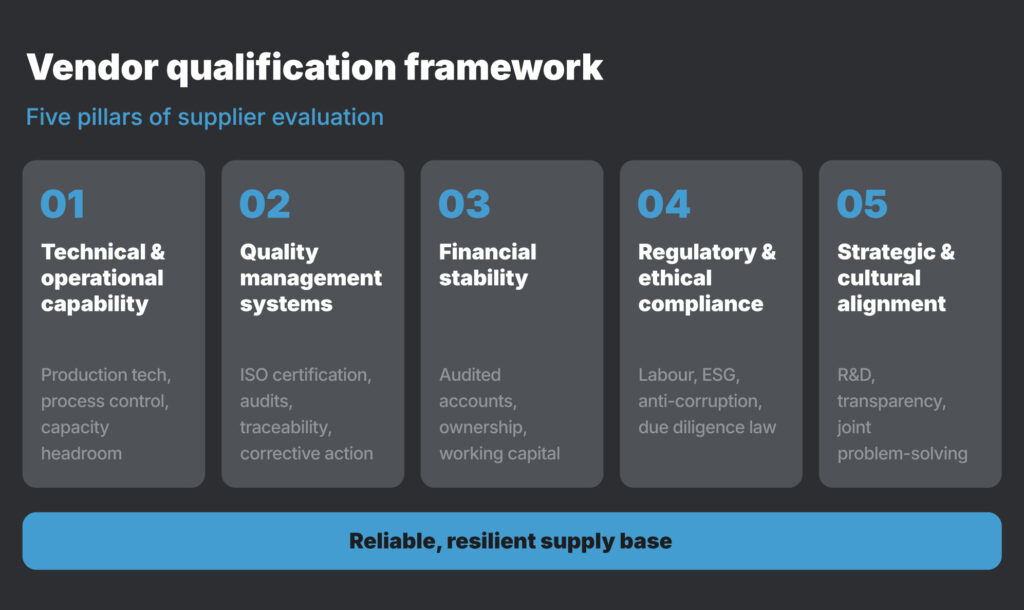
The Five Pillars of a Rigorous Supplier Assessment
Although the weighting of evaluation criteria varies by industry, product category, and strategic objective, a credible supplier assessment framework rests upon five core pillars. Each should be evaluated through documented evidence rather than supplier self-declaration alone.
1. Technical and Operational Capability
The first pillar examines whether the vendor is able to produce the required product reliably, to specification, at the required volume, and within agreed lead times. Evaluation should address production technology, equipment condition, process control maturity, engineering depth, and capacity headroom relative to forecast demand.
For organisations sourcing in Asia, technical due diligence should also assess the supplier’s experience within the relevant product category, particularly for components involving tight tolerances, regulated materials, or specialist finishing processes. A factory visit conducted by qualified engineers, supported by structured capability questionnaires, remains the most reliable method of validating technical claims.
2. Quality Management Systems
Certification to internationally recognised standards, including ISO 9001, IATF 16949 for automotive applications, ISO 13485 for medical devices, and AS9100 for aerospace, provides a baseline indication of quality system maturity. Certification alone, however, is insufficient. Auditors should examine incoming inspection protocols, in-process controls, non-conformance management, and corrective action effectiveness.
A mature quality system is characterised by data-driven decision-making, traceability across the production chain, and demonstrable continuous improvement. These attributes are strong predictors of long-term supplier performance.
3. Financial Stability and Commercial Viability
A technically capable supplier in financial distress represents an unacceptable continuity risk. Financial due diligence should examine audited accounts, credit ratings where available, ownership structure, customer concentration, and working capital adequacy. For privately held vendors, which are common across Asian manufacturing, alternative indicators such as payment history with raw material suppliers, workforce stability, and facility investment patterns can provide meaningful signal.
The McKinsey analysis on supply chain resilience observes that financial visibility into critical suppliers is one of the most underdeveloped capabilities in many procurement organisations, and a frequent root cause of disruption.
4. Regulatory and Ethical Compliance
The scope of compliance evaluation has broadened considerably in recent years. Beyond product safety and environmental regulation, modern vendor qualification must address labour standards, anti-corruption controls, data protection where relevant, and increasingly, ESG performance.
For organisations sourcing through a sourcing company in China or other Asian markets, third-party social compliance audits provide structured assurance. Customer-facing organisations should also evaluate their exposure to emerging supply chain due diligence legislation in major markets, which is progressively transferring accountability for upstream practices to the buying entity.
5. Strategic and Cultural Alignment
The final pillar considers whether the supplier is capable of supporting the organisation’s longer-term direction. Relevant indicators include R&D investment, responsiveness during qualification, transparency in communication, and willingness to engage in joint problem-solving. Strategic alignment carries particular weight in relationships expected to involve supplier development strategies, technology co-development, or capacity expansion over time.
A Sample Supplier Scoring Matrix
Translating the five pillars into a scoring model establishes the consistency required for objective comparison. The illustrative matrix below may be adapted by category and risk profile.
| Evaluation Pillar | Indicative Weight | Scoring Scale (1–5) | Minimum Acceptable Score |
| Technical & Operational Capability | 25% | 1 = Inadequate, 5 = Best-in-class | 3 |
| Quality Management Systems | 25% | 1 = No certification, 5 = Mature, data-driven QMS | 4 |
| Financial Stability | 15% | 1 = Distressed, 5 = Strong balance sheet | 3 |
| Regulatory & Ethical Compliance | 20% | 1 = Non-compliant, 5 = Independently verified | 4 |
| Strategic & Cultural Alignment | 15% | 1 = Misaligned, 5 = Strategic partner profile | 3 |
Weighted scores falling below an agreed threshold, for example 3.5 out of 5, should trigger either disqualification or a documented remediation plan prior to contracting.
Structuring the Supplier Selection Process
A disciplined supplier selection process progresses through clearly defined stages, each generating documented evidence that informs the next. The omission or compression of stages typically creates qualification gaps that surface at a later date, often at significant cost.
STAGE ONE: MARKET MAPPING AND LONG-LISTING
The process commences with structured market intelligence to identify the population of vendors capable of meeting the technical and commercial requirements. For organisations newly entering a given region, supplier sourcing services with established local networks can accelerate this phase by surfacing qualified candidates that directory-based searches would overlook.
STAGE TWO: PRE-QUALIFICATION AND SHORTLISTING
Supplier shortlisting applies an initial filter against non-negotiable requirements, including certifications held, capacity range, financial thresholds, and category experience. A well-designed pre-qualification questionnaire (PQQ) collects standardised data that supports objective comparison and forms the basis for the shortlist advancing to detailed evaluation.
STAGE THREE: ON-SITE AUDIT AND CAPABILITY VERIFICATION
For shortlisted vendors, on-site audits conducted by qualified personnel remain the recognised standard. Audits should follow a structured protocol covering production, quality, compliance, and commercial dimensions, and should produce a defensible audit record supporting the final selection decision.
STAGE FOUR: SAMPLE VALIDATION AND PILOT PRODUCTION
Prior to any commercial commitment, prospective suppliers should produce validated samples or complete a limited pilot run against the full production specification. This stage tests the alignment between stated capability and actual output, and frequently reveals issues that documentary review cannot detect.
STAGE FIVE: CONTRACTING AND ONBOARDING
The process concludes with contractual formalisation, encompassing quality agreements, intellectual property protections, performance metrics, and exit provisions, followed by structured onboarding. Robust contracting at this stage establishes the governance framework under which the relationship will operate.

A Practical Supplier Assessment Checklist
The following checklist consolidates the minimum evidence base required before any new supplier is approved for commercial activity.
Documentation Review
- Business licence and registration documents
- Audited financial statements (most recent two to three years)
- Relevant ISO and industry-specific certifications
- Insurance certificates (product liability, workers’ compensation)
- Quality manual and standard operating procedures
- List of major customers and reference contacts
On-Site Audit
- Facility tour with photographic record where permitted
- Verification of equipment list against declared capacity
- Review of incoming inspection and final inspection records
- Review of non-conformance and corrective action logs
- Worker interviews regarding hours, pay, and safety
- Inspection of dormitories, canteens, and chemical storage
Commercial and Compliance
- Pricing structure and cost breakdown
- Payment terms and currency exposure
- Anti-bribery and code of conduct acknowledgement
- Subcontractor disclosure and visibility
- Data protection and IP handling protocols
Sample Audit Questions Worth Asking
The quality of audit findings frequently depends upon the precision of the questions asked. The examples below probe areas in which vendors most commonly overstate capability.
- What was your on-time delivery rate over the past 12 months, and how is it measured?
- What percentage of output was reworked or scrapped last quarter, and what were the root causes?
- Who are your three largest customers, and what percentage of revenue do they represent?
- How do you qualify and audit your own raw material suppliers?
- What was the most recent product recall or customer complaint, and how was it resolved?
- What is your current workforce turnover rate, and how do you manage seasonal demand?
- How do you protect customer designs and tooling from unauthorised use?
A Risk-Weighting Reference Table
Not every supplier warrants the same depth of assessment. The risk-weighting table below provides a straightforward method of calibrating effort to exposure.
| Supplier Tier | Spend / Strategic Importance | Recommended Assessment Depth | Reassessment Frequency |
| Tier 1 — Critical | High spend, sole source, or strategic component | Full audit, financial review, ESG verification | Annually |
| Tier 2 — Important | Significant spend, multiple sources available | On-site audit, PQQ, sample validation | Every 18–24 months |
| Tier 3 — Standard | Lower spend, commoditised goods or services | Documentary review and remote audit | Every 24–36 months |
Beyond Selection: The Role of Supplier Development
A common misconception treats supplier assessment as a discrete event concluding at contract award. In practice, leading procurement organisations regard qualification as the starting point of an ongoing performance management cycle, supported by vendor development services that build supplier capability over time.
Effective supplier development strategies typically combine performance scorecards, structured feedback, joint improvement projects and, where the relationship justifies such investment, direct support of supplier capability. BCG’s research on procurement resilience indicates that organisations applying systematic supplier development consistently extract greater value from their supply base than those treating suppliers as interchangeable.
Supplier Assessment in Cross-Border and Asian Sourcing Contexts
The principles of rigorous vendor qualification apply universally; their execution, however, requires adaptation when sourcing across borders. Organisations engaged in global sourcing solutions, particularly those working with manufacturing partners in China and the wider Asian region, face additional considerations that warrant deliberate attention.
Language and communication protocols, time-zone management, intellectual property frameworks, and on-the-ground audit logistics introduce complexity that may compromise assessment quality if not actively managed.
Supply chain visibility tools, including supplier performance dashboards, milestone tracking, and exception reporting, have become essential infrastructure for organisations managing distributed supply bases at scale.
Engaging regional partners with established networks, qualified audit personnel, and integrated procurement services reduces the friction of cross-border assessment and strengthens the quality of the resulting qualification decision. A trusted partner with on-the-ground presence can compress timelines that would otherwise extend over many months.
Common Pitfalls in Supplier Assessment
Even well-resourced procurement functions encounter recurring failure modes during vendor qualification. The most common include:
- Over-reliance on supplier self-declaration without independent verification
- Insufficient weighting of financial and compliance risk relative to commercial terms
- Compression of the qualification timeline under commercial pressure
- Inadequate documentation of audit findings
- Failure to revalidate suppliers periodically once onboarded
Each of these failure modes is preventable through procedural discipline and an evidence-based assessment framework.
Building a Supplier Assessment Framework That Scales
For organisations operating across multiple categories, regions, and product lines, the supplier selection process must be both rigorous and scalable. A standardised framework, with category-specific tailoring, enables consistent decision-making, supports benchmarking across the supply base, and generates the data infrastructure required for advanced supplier analytics.
Investment in such a framework typically yields a return through lower supplier failure rates, improved total cost of ownership, faster qualification timelines, and stronger negotiating positions informed by structured supplier intelligence.
Conclusion: Qualification as the Foundation of Sourcing Success
The discipline of supplier assessment sits at the intersection of procurement, quality, finance, and strategy. Approached with rigour, it transforms vendor selection from a procurement task into a source of competitive advantage, building a supply base capable of delivering reliable quality, predictable cost, and the resilience required in volatile global markets.
The frameworks, checklists, and scoring tools set out in this guide reflect the standard expected of mature procurement organisations. For businesses sourcing across Asian manufacturing markets, the additional complexity of cross-border operations renders regional supplier sourcing services, supported by robust supply chain visibility infrastructure, a practical necessity rather than a discretionary choice.
Organisations currently reviewing their vendor qualification approach, or evaluating sourcing partners across China and the wider Asian region, are encouraged to engage experienced regional procurement specialists to discuss their specific requirements and to pressure-test their existing framework.
Related reading: Third-party lab testing for product compliance and ESG audit services for global supply chains.
